
Finding Your Visual Voice — Inspired by Georgia O'Keeffe
'I found I could say things with color and shapes that I couldn't say any other way — things I had no words for.' A step-by-step exercise for sewing together your own visual vocabulary.
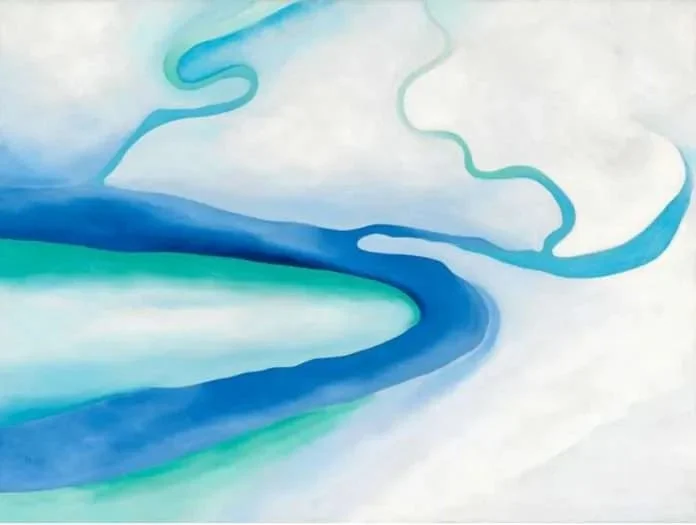
"I found I could say things with color and shapes that I couldn't say any other way — things I had no words for." — Georgia O'Keeffe
Georgia O'Keeffe's visual language was uniquely her own — an alchemy developed over years of experimentation with abstraction, sensual forms, scale, and composition that allowed her to express herself without words. She spoke her own language of color and shapes and told new stories about the world to us. Her unique visual language expressed deep emotion through many non‑realistic representations of her subjects.
Looking at her visual language was about translating what she felt — her own inner vision — into a form the viewer could experience viscerally. Over the years, I have personally discovered the joy and release of developing my own visual language, which has helped me expand my interests in art viewing and my range in art making.
By following in O'Keeffe's footsteps, you too can begin stitching together your own visual vocabulary by integrating your own ideas, thoughts, and feelings into creative expressions. This post features a few hands‑on mini‑exercises that you can sew together to develop your own visual preferences. It doesn't have to make perfect sense, or be "good enough" for anyone else — it has to mean something to only you.
Developing a visual language takes time, courage, and a willingness to pivot, make some really ugly pictures, and have a sense of humor. The goal is to encourage you to experiment and make different kinds of marks, shapes, and colors, while referencing back to Georgia O'Keeffe's pictures. Your visual preferences are created by asking yourself honest questions and learning what you like, and don't like. This process can be so empowering, but it takes patience, practice, and perseverance. Take notes if you can — it really helps.
What you'll need
- Color (watercolor, crayons, etc.)
- Brushes
- Paper — I love using a plain sketchbook, but any paper works.
Step 1. Identify how you're feeling right now
Write down 3–5 words or pairs of words that describe how you feel at this moment.
Example: 1) Squishy, 2) A little off, 3) On edge, 4) Excited, 5) Alert.
Step 2. Pair your words with color
What color or combination of colors do you associate with your words? Don't overthink it — grab a color and see; go back and change it if it doesn't work.
In my example, I found that the combo of orange and ultramarine blue was perfect for all the words, but didn't mix well.
Step 3. Look at Georgia's work
Preview 4–5 Georgia O'Keeffe pictures (try Rams Head White in Hollyhock‑Hills, Poppies, Green Lines and Pink, Brooklyn Bridge). In your sketchbook, answer:
- Do you notice themes or patterns in her shape and color choices?
- What thoughts or feelings do those colors, shapes, or patterns elicit in you?
- Choose one image you have a strong preference toward — like or dislike.
Go deeper. When you look at this picture, describe exactly what you see — the marks, the lines, the shapes, the colors. Get as detailed and specific as you can. Your brain needs this analysis to begin creating your own visual language.
Example: I see four images: a sky, bones, a flower, and a landscape. I see the colors: orange (a few variations), brown, white, green, and more. The colors get stronger and weaker.
How does this picture make you think and feel?
Example: This makes me feel curious, content, and balanced.
State your preference clearly.
Example: I like this picture because I love seeing bones with a flower with a landscape. It makes me want to know more, and I enjoy not understanding the connection of the objects in the context of the landscape. I don't like bones, so this doesn't make sense to my logical brain. But the combination of these images is so compelling and unusual.
Step 4. Final synthesis
Look at one or more of your painting responses and see if you can spot any patterns in your likes and dislikes. Are there specific colors that make you feel joy? Are there shapes you don't like? Jot them down — share them with someone.
This is only the beginning of delineating your own visual preferences. Hopefully, when you are making art, this can inspire you to create marks, colors, and shapes you naturally are drawn to. By working both sides of being the maker and the observer, you will find yourself growing your language. This is a process of building your vocabulary — it takes time and experimentation.
Enjoy it.
- georgia o'keeffe
- visual voice
- exercise
Originally published on Beautiful Art Ache on Substack .